Tiles may look perfectly smooth and polished after installation. However, what most homeowners do not see are the problems hidden underneath. Some of these issues include hollow sounds, cracked joints, slipping tiles, uneven edges and loose corners. Such common problems often begin because the wrong fixing method was used during installation.
This becomes even more challenging when tiles are installed on curved surfaces, rounded walls, pillars, arches or large-format feature walls. Traditional tiles cement mixtures often struggle to hold heavy tiles securely on such surfaces. This leads to alignment issues and long-term failures.
Hence, modern tile glue adhesive solutions are becoming essential in today’s homes and commercial spaces. Products like Birla White TileStix Curvefit are specially designed for large-format and curved tile installations where flexibility and adhesion become critical.
Flat surfaces are comparatively easier to tile because the pressure distribution remains even. However, curved surfaces create constant stress points underneath the tiles. This often leads to common installation problems like:
Large-format tiles make this even more difficult because bigger tiles naturally experience higher internal stress when bent around curves or uneven surfaces. This is exactly why a high-quality adhesive on tile is important. Unlike ordinary cement mortar, highly polymer-modified adhesives are designed to absorb movement, vibration and thermal expansion without transferring stress directly to the tile surface.
The best glue to stick to tile is a high-performance polymer-modified tile adhesive that offers strong bonding, flexibility and water resistance. Products like Birla White TileStix Curvefit are specially designed to provide strong adhesion even on challenging curved surfaces and large-format tile applications. Its highly deformable formulation helps tiles stay securely fixed while reducing the risk of cracking, lifting or hollow spots over time.
Modern tile glue adhesive products work very differently from traditional cement-sand fixing methods. Birla White TileStix Curvefit offers strong adhesion, sag resistance, flexibility and extended open time for better handling during installation. Here’s how it helps prevent common tile installation issues:
| Common Problem | How TileStix Curvefit Helps |
|---|---|
| Tiles slipping on walls | Sag-resistant formula keeps tiles stable during installation. |
| Cracked tiles or joints | High flexibility absorbs substrate movement. |
| Hollow or loose tiles | Strong polymer bonding improves adhesion. |
| Problems on curved surfaces | Highly deformable adhesive adjusts to movement. |
| Failure in wet areas | Water-resistant formulation improves durability. |
| Tile damage due to heat | Sustains thermal expansion and heat ageing. |
| Installation delays | Extended open time allows easier tile positioning. |
This makes it especially useful for designer walls, curved structures, balconies, facades and terraces.
Yes, modern tile adhesives are generally stronger and more flexible than traditional cement mortar for tile installations. Ordinary tiles cement mixtures may work for basic applications but they often struggle with large-format tiles and curved surfaces. German polymer-modified adhesives like TileStix Curvefit are designed to offer:
The best tile adhesive is one that offers strong adhesion, flexibility, durability and compatibility with modern tile applications. For challenging installations like curved walls, products like Birla White TileStix Curvefit are designed to handle movement, vibration and thermal expansion more effectively than ordinary cement mortar.
TileStix Curvefit is suitable for a wide range of applications, including interior and exterior floors, walls, tile-on-tile installations, drywall applications and even high-vibration commercial areas. It can be used with ceramic tiles, vitrified tiles, porcelain tiles, glass mosaics and natural stones like granite and marble.

Type 2 tile adhesive generally refers to advanced adhesive formulations designed for better water resistance and flexibility. These adhesives are commonly used in bathrooms, balconies, terraces, exterior walls and large-format tile installations where ordinary fixing materials may fail over time. Highly polymer-modified adhesives like Birla White TileStix are especially preferred because they help tiles withstand movement and moisture.
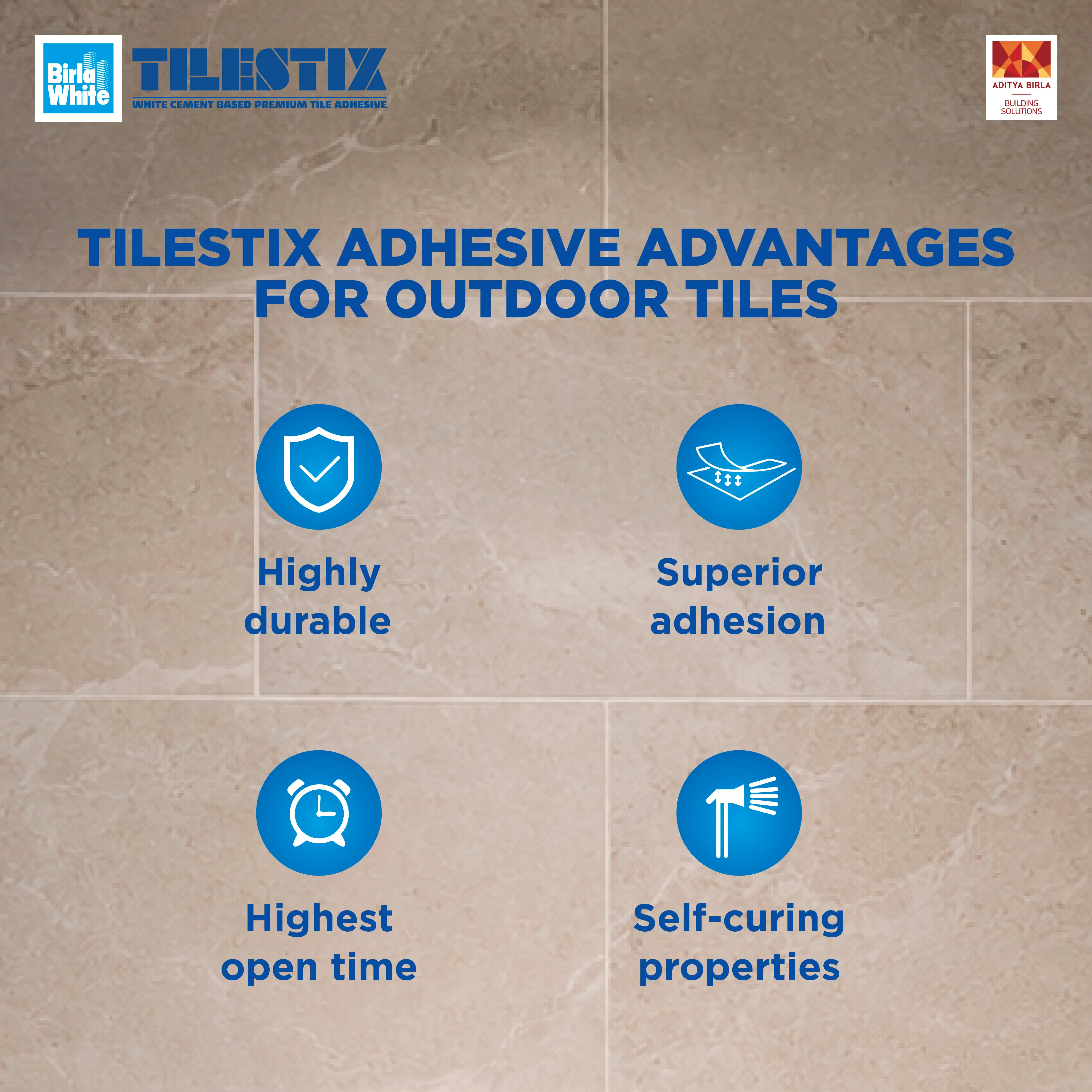
As modern homes use larger tiles, traditional fixing methods are often not enough for curved surfaces and complex designs. Modern adhesive on tiles offers stronger bonding, better flexibility and improved durability. These advantages help prevent common tile installation problems. For reliable solutions designed for modern construction needs, explore the Birla White TileStix range at www.birlawhite.com.
Fill out this form to talk to our experts.
Our team typically replies in 24 hours.