Choosing between paint and distemper can significantly affect how your walls look, how long the finish lasts, and how often you need maintenance. While both are used to add colour and finish to walls, they differ in composition, durability, appearance, maintenance, and cost.
If you are wondering whether distemper paint on wall is suitable for your home or whether you should choose modern emulsion paint, this guide breaks down the key differences to help you make the right decision in 2026.
Confused between paint and distemper for your next home makeover? If you want an economical finish without compromising on durability and brightness, explore Birla White TRUTONEx Distemper Paint—a white cement-based, polymer-modified solution designed for beautiful interior walls with enhanced washability and 30% more coverage. Discover a smarter way to give your walls lasting colour and value.
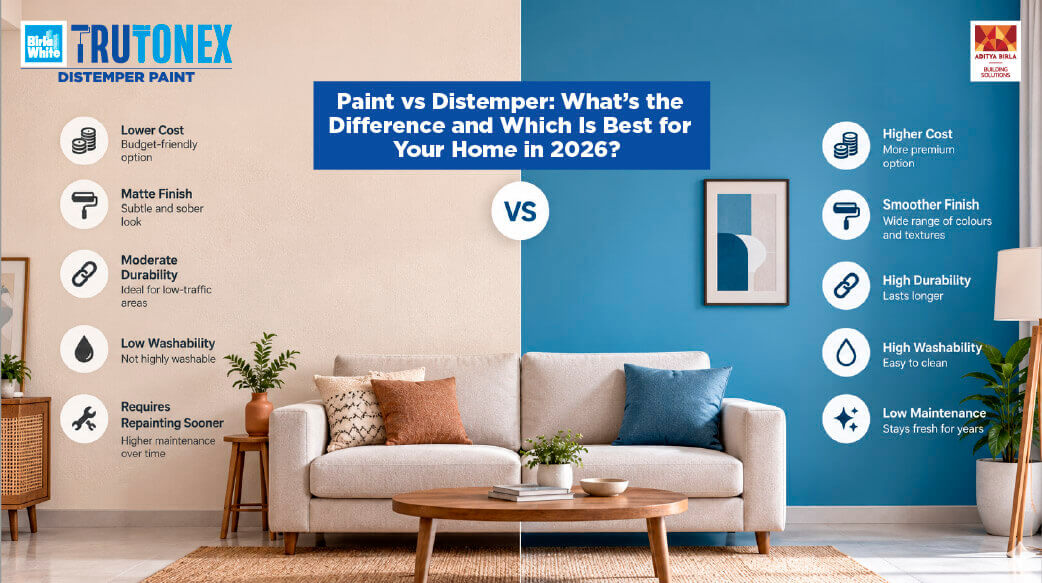
The right finish isn't simply about choosing between paint and distemper—it’s about finding the right balance of cost, coverage, durability and appearance. For homeowners looking for an affordable alternative with enhanced performance, Birla White TRUTONEx Distemper Paint combines white cement and polymer technology to deliver durable walls, better washability and 30% more coverage. Check out the table below to know more about the difference between paint vs distemper.
Give your walls more than colour. Give them a finish designed for lasting value.
| Feature | Emulsion Paint | Distemper |
|---|---|---|
| Finish | Smooth, rich and more uniform | Soft, matte finish |
| Durability | Generally higher | Generally lower |
| Washability | Many paints offer good washability | Usually limited |
| Colour options | Wide range of colours and finishes | Available in multiple shades |
| Maintenance | Easier to clean, depending on paint type | May require more frequent touch-ups |
| Moisture resistance | Varies by paint type; generally better with suitable formulations | Usually lower than modern interior paints |
| Cost | Usually higher | Generally more economical |
| Ideal for | Living rooms, bedrooms, exteriors and premium interiors | Budget-friendly interior applications |
Performance can vary depending on the specific product, surface preparation and application conditions.
Paint is a wall-finishing material designed to provide colour, protection and a specific surface finish. Modern interior paints are available in several formulations, including emulsion and other water-based options.
Depending on the product, paint can offer:
For homeowners looking for a long-lasting decorative finish, paint is often preferred for areas such as living rooms, bedrooms, hallways and children's rooms.
Distemper is a traditional and economical wall-finishing option commonly used for interior walls. It provides a simple matte appearance and is available in a variety of distemper colours.
One of its biggest advantages is affordability, making it useful when you want to refresh large wall areas while keeping the overall painting budget under control.
However, compared with many modern paints, distemper generally offers lower washability and durability.
Distemper paint on wall surfaces can work well in areas where:
When comparing paint and distemper, durability is one of the biggest differences.
Quality interior paints are generally designed to withstand everyday use better than conventional distemper. They can be a better choice for walls exposed to frequent touching, dust and cleaning.
Distemper is more suitable when affordability is the primary consideration and the walls do not require heavy-duty performance.
Paint generally provides a more refined and uniform appearance, depending on the finish selected. You can choose from options such as matte, satin or other finishes depending on the product.
Distemper usually provides a soft, understated matte finish. If you prefer a simple and traditional wall appearance, distemper paint on wall can be an economical choice.
This is another important consideration.
Many modern paints are formulated to offer better washability, making them suitable for areas where walls may need occasional cleaning.
Traditional distemper is generally less washable. Excessive rubbing or repeated cleaning can affect its finish.
Tip: If you have young children, pets or high-traffic areas at home, consider a washable paint designed for interior walls.
Modern paints offer a broad selection of shades and finishes. You can easily coordinate wall colours with furniture, flooring and décor.
Distemper is also available in several distemper paint colours, although the range and finish options may differ from those available in premium interior paints.
If your primary concern is the initial painting budget, distemper can be an economical option.
Paint generally costs more, but the additional investment can provide advantages such as improved durability, appearance and maintenance, depending on the product selected.
Therefore, don't compare only the initial price. Consider coverage, number of coats, expected lifespan and maintenance requirements before making your decision.
There is no single answer for every home.
Choose paint if you want:
Choose distemper if you want:
In short, paint is generally the better choice for long-term performance and premium finishes, while distemper can be a practical choice when keeping costs low is the priority.
Choosing the right product is only one part of achieving good results. Proper surface preparation and application are equally important.
Remove dust, dirt, loose material and old, flaky coating. Repair visible cracks, holes and surface imperfections before applying the finish.
Moisture can affect the adhesion and appearance of a wall finish. Address dampness or seepage issues before painting.
A suitable primer or base preparation can help create a more uniform surface and improve the overall finish.
Follow the manufacturer's recommended dilution, application method and drying time. Apply coats evenly rather than trying to achieve complete coverage with one heavy coat.
Give each coat sufficient time to dry before applying the next. This helps minimise unevenness and improves the final appearance.
Before making your decision, ask yourself these five questions:
For bedrooms or low-traffic spaces where budget is important, distemper may be sufficient. For living rooms, hallways and frequently used spaces, a suitable interior paint can offer greater durability and easier maintenance.
A beautiful wall starts with the right surface preparation. Before applying paint or distemper, make sure the wall is properly prepared for a smooth and long-lasting finish.
For homeowners choosing distemper paint, Birla White Distemper Paint can be explored as an economical wall-finishing option designed for interior applications.
Ready to refresh your walls? Explore our Distemper Paint and give your interiors a clean, fresh finish without overcomplicating your painting project.
Paint is generally preferred when durability, washability, appearance and long-term performance are priorities. Distemper can be a more economical option for basic interior wall finishing.
It depends on the condition and existing finish of the wall. Proper surface preparation, including cleaning, repairs and suitable base preparation, is important before applying distemper.
The lifespan depends on the product, surface preparation, environmental conditions, application and maintenance. Distemper generally requires repainting sooner than more durable modern paint systems.
Traditional distemper generally has limited washability compared to Birla White TRUTONEx Distemper Paint, which provides better washability. Always check the specific product's specifications before cleaning the surface.
Distemper is generally the more economical option in terms of initial wall-finishing cost. However, total cost should also consider durability, repainting frequency and maintenance.
Popular choices include whites, off-whites, creams, soft greys, pastel blues and subtle greens. The right distemper paint colour depends on your room size, natural lighting, furniture and décor.
Fill out this form to talk to our experts.
Our team typically replies in 24 hours.