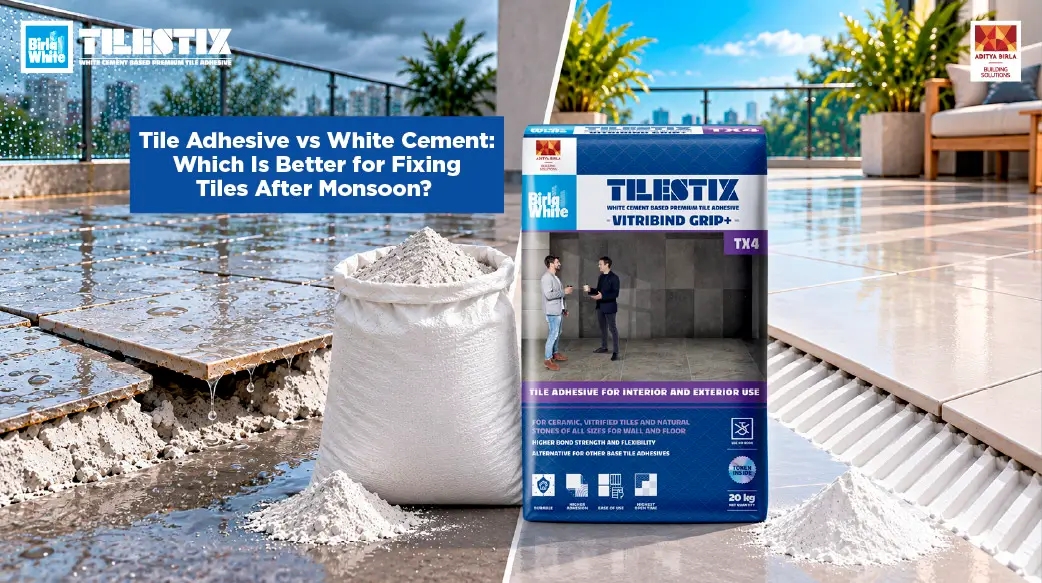
The monsoon has passed, but your home may still be showing signs of the season. A loose bathroom tile, a hollow sound when you tap the floor, or a tile that has started to shift can be more than a minor inconvenience. Moisture can expose weak bonding and make tile repairs especially important after prolonged rain and humidity.
But when it is time to fix those tiles, one common question comes up: Should you use white cement or tile adhesive?
While both materials can be used in tile-related applications, they serve different purposes. Tile adhesive is specifically formulated to bond tiles to suitable surfaces, while white cement is primarily a cementitious material that may be used for other finishing and construction applications.
So, which one should you choose for fixing tiles after monsoon? Let’s understand the difference.
Don’t let loose tiles become a lasting post-monsoon problem. Before you reach for white cement, discover how the right tile adhesive can help create a stronger, more reliable bond. Explore Birla White’s tile adhesive solutions and find the right foundation for your tiles.
Monsoon weather can create conditions that affect tile installations, particularly in areas exposed to moisture.
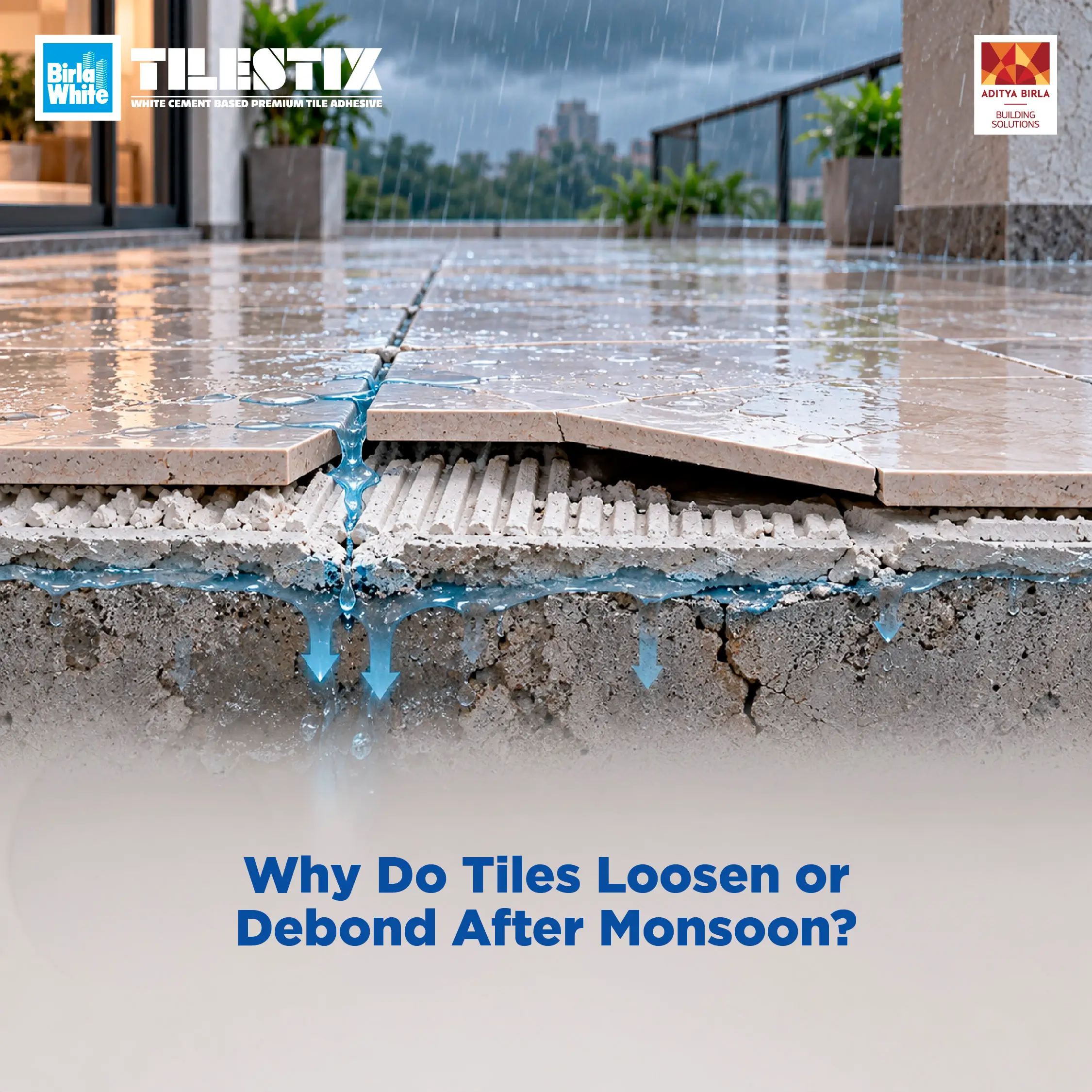
Water can enter through damaged grout joints, cracks, porous surfaces or existing waterproofing issues. Repeated exposure to moisture, along with temperature and humidity changes, can contribute to deterioration of the bonding layer or substrate.
You may notice:
However, the solution is not simply to put a new bonding material over the existing problem. Before fixing a loose tile, the surface and source of moisture should be assessed.
The biggest difference is their intended application.
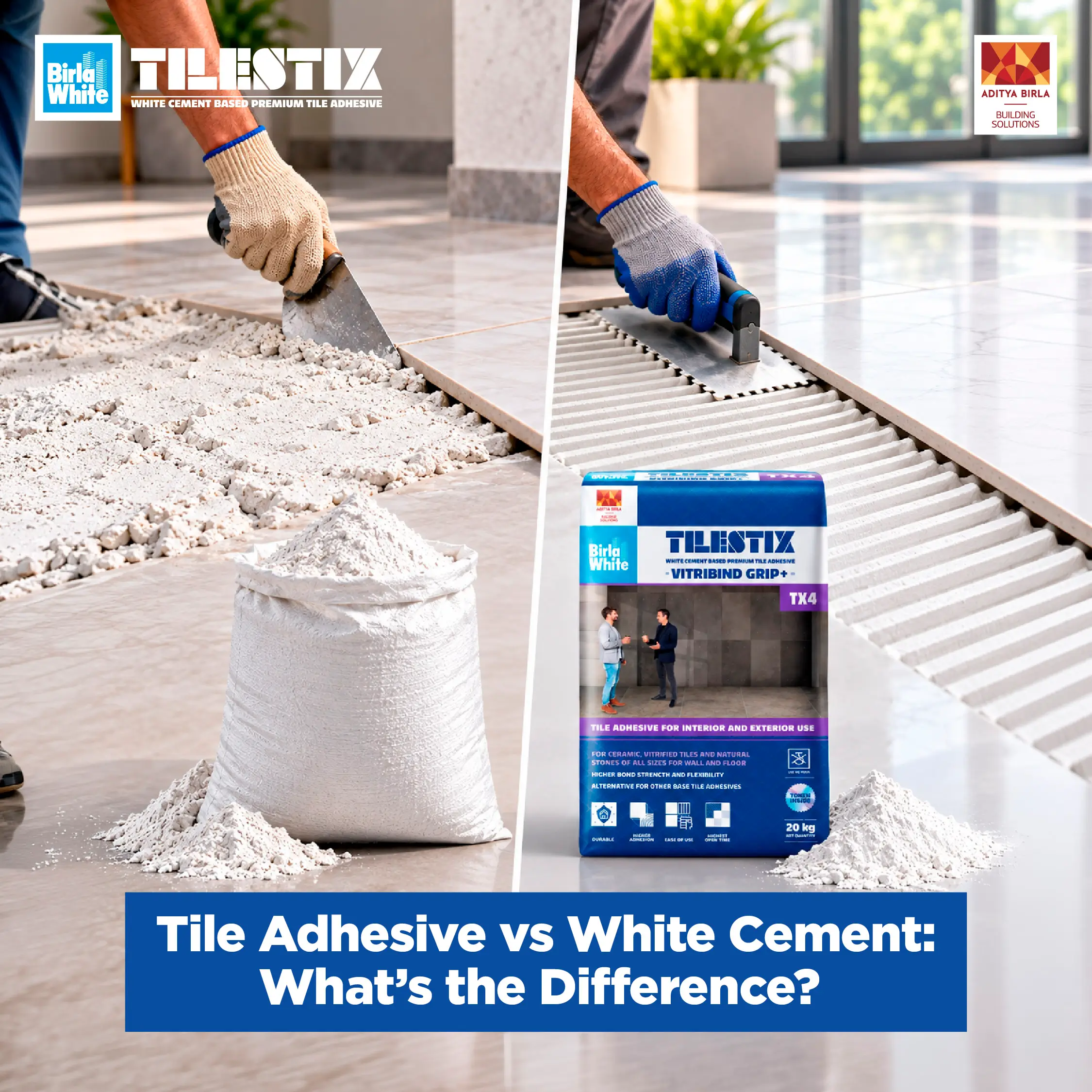
Tile adhesive is manufactured specifically for fixing tiles to suitable substrates. Depending on the product formulation, tile adhesives can be designed for different tile types, surfaces and applications.
White cement, on the other hand, is a cement-based material commonly used for finishing and other construction applications. It is not automatically a substitute for a purpose-designed tile adhesive.
| Feature | Tile Adhesive | White Cement |
|---|---|---|
| Primary purpose | Tile installation and bonding | Construction and finishing applications |
| Designed specifically for tiles | Yes | No |
| Application consistency | Formulated for tile fixing | Depends on the application |
| Suitable for modern tile installation | Depends on adhesive and tile type | May not be the appropriate choice |
| Application | Usually prepared and applied according to product instructions | Mixed according to its intended use |
| Tile compatibility | Product-specific | Not specifically formulated for every tile type |
The important point: the choice should be based on the tile, substrate and application rather than simply choosing the material that appears most convenient.
When repairing or installing tiles, using a product designed specifically for tile fixing can make the process more straightforward.
A tile adhesive is formulated to bond tiles to compatible surfaces. This makes it different from using a general cement-based material for an application it was not specifically designed for.
Following the manufacturer's recommended mixing and application method can help create a more uniform layer beneath the tile.
The right adhesive for tile applications also depends on proper trowel technique, coverage and surface preparation. Applying too little adhesive or using an unsuitable method can leave voids beneath the tile.
Different tiles and surfaces may require different adhesive solutions. Large-format tiles, ceramic tiles, vitrified tiles and tiles used in wet areas can have different installation requirements.
Therefore, rather than looking for a one-size-fits-all tile cement, check whether the adhesive is suitable for your particular tile and substrate.
When replacing a loose or damaged tile, a suitable tile adhesive can make the repair process more practical, provided the existing substrate is sound and properly prepared.
White cement and tile adhesive should not be treated as interchangeable products.
White cement has applications in construction and finishing, but tile installation requires consideration of factors such as:
If you are fixing modern tiles, particularly in areas exposed to moisture, choosing a product specifically designed for tile installation can be a more appropriate approach than assuming ordinary white cement will work for every situation.
The terms tile adhesive cement and tile cement are sometimes used casually when discussing tile installation. However, the name alone should not determine what product you choose.
Tile adhesives are specially formulated products intended for tile fixing. Their composition and performance characteristics can vary depending on the product and application.
So, when buying a tile fixing product, don't select it only because it is described as "cement." Instead, check the product specifications and confirm that it is suitable for your tile and surface.
In some renovation situations, tiles may be installed over an existing tiled surface. However, this is not automatically suitable for every project.
The existing tiles must be firmly bonded, clean, stable and compatible with the proposed installation system. The surface may also require preparation to improve adhesion.
Therefore, before applying adhesive on tile, check the adhesive manufacturer's recommendations for tile-on-tile installation.
If the goal is specifically to fix or install tiles, a purpose-designed tile adhesive is generally the more relevant product category to consider.
However, the correct choice still depends on the tile, substrate and application conditions. For example, an adhesive suitable for a standard indoor ceramic tile installation may not necessarily be the right choice for a large-format tile, exterior application or demanding wet-area installation.
The key is to choose the right tile adhesive for the specific application, rather than treating every tile fixing project the same way.
Looking for a reliable solution for your tile installation needs? Explore Birla White's tile adhesive solutions and choose a product designed to help you create a strong, dependable foundation for your tiles.
Tile adhesive is specifically formulated for tile installation, whereas white cement has different construction and finishing applications. The appropriate choice depends on the tile, substrate and installation conditions.
White cement should not automatically be considered a substitute for tile adhesive. For tile installation, select a product specifically recommended for the particular tile and substrate.
"Tile adhesive cement" is a commonly used term for cement-based tile adhesive products. However, product formulations and applications vary, so always check the manufacturer's specifications.
Fill out this form to talk to our experts.
Our team typically replies in 24 hours.