Your Roof Doesn't Need Another Patch. It Needs a Waterproofing Strategy. A small crack on your terrace may seem innocuous.
One rainfall transforms into a damp patch. The damp patch transforms into a ceiling stain. The stain transforms into peeling paint, mould or recurring leakage — and the next thing you know, a small roof problem has transformed into an expensive home repair project.
Therefore, when choosing a waterproofing chemical for terrace surfaces, you must think about a solution that is appropriate to your roof, manages water exposure and is applied correctly.
But with cementitious coatings, polymer-modified waterproofers, elastomeric coatings and membrane systems, which is the best waterproofing chemical for roofs in India?
The answer depends on your roof and what kind of protection it needs.
For horizontal RCC, concrete and cementitious surfaces such as terraces, Birla White Seep Guard Horizontal Surfaces is specially formulated as a white cementitious polymer high-performance coating. With documented features including hydrostatic pressure resistance, crack-bridging properties, high adhesion and 8 year waterproofing warranty.
Don't wait for the next monsoon to inform you where your roof is weak. Explore Birla White Seep Guard for a smarter way to terrace and roof waterproofing.
A roof waterproofing chemical is a coating, treatment or formulation that is used on a roof or terrace to reduce water penetration and protect the underlying surface against moisture damage.
Depending on the technology of the product, waterproofing systems can help:
However, waterproofing is not as simple as applying a chemical on a leaking surface.
Surface preparation, crack repair, drainage, application thickness, number of coats and drying time can all affect waterproofing.
Different types of roofs may need different waterproofing techniques. Here are some of the commonly used categories.
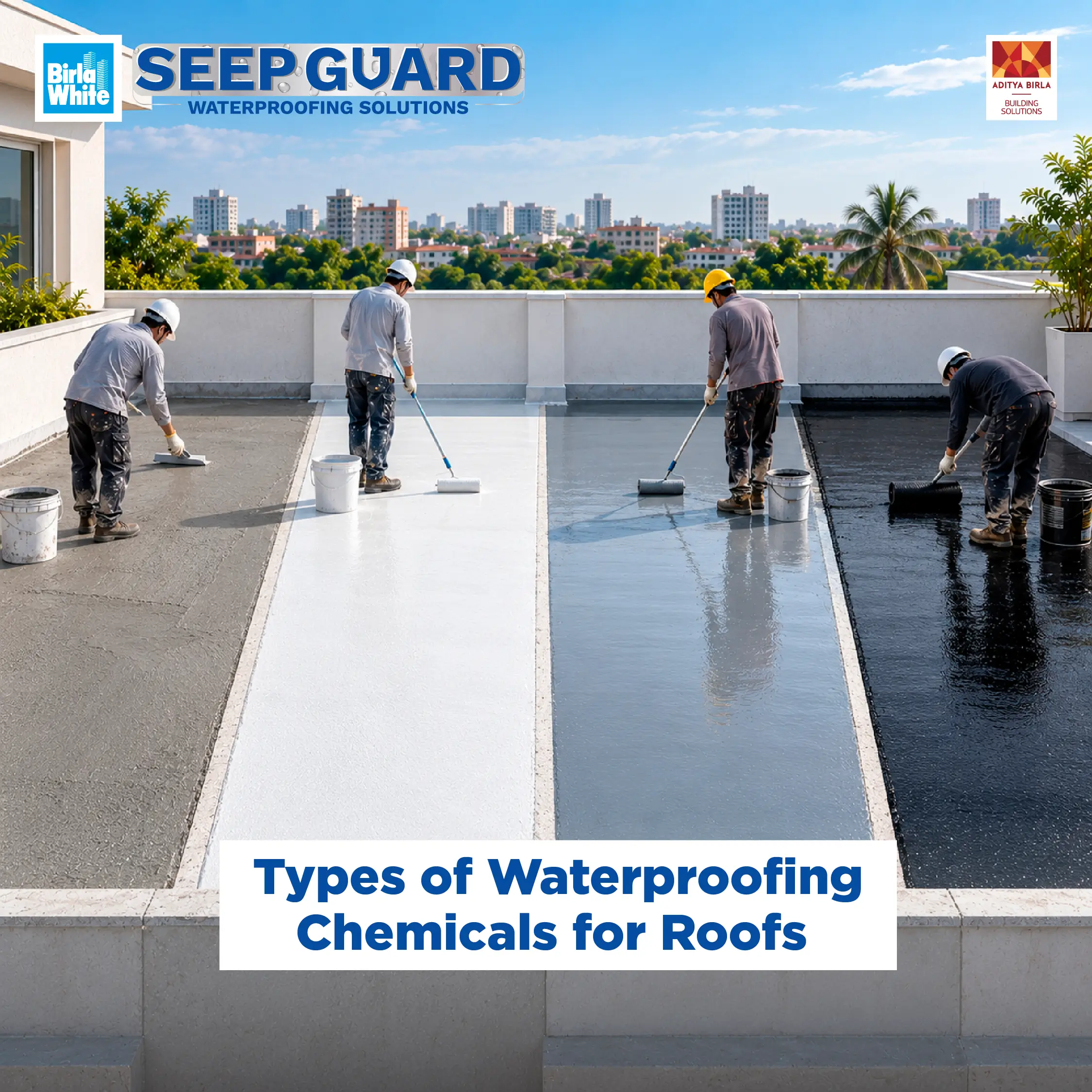
Cementitious waterproofing generally involves a mixture of cement-based materials with polymers and additives to create a water-resistant protective layer.
They can be suitable for concrete, RCC and cementitious surfaces if the product is particularly formulated for these applications.
Best suited for:
RCC roofs, concrete terraces, balconies and other cementitious surfaces, depending on the manufacturer's specifications.
Why consider it?
Cementitious systems can offer good substrate compatibility and are relatively easy to apply if the surface has been adequately prepared.
Polymer-modified formulations are a combination of cementitious components with polymers to enhance properties such as adhesion, flexibility and water resistance.
These systems can be useful in instances where the waterproofing layer will need to accommodate some degree of surface motion.
Best suited for:
Concrete and cementitious surfaces where enhanced adhesion and flexibility are required.
Birla White Seep Guard Horizontal Surfaces combines white cement with German elastomeric polymer technology and is formulated for horizontal RCC, concrete and cementitious surfaces.
Elastomeric coatings are designed to provide a flexible waterproofing layer capable of accommodating certain minor movements and cracks, depending on the product formulation.
Best suited for:
Surfaces that are exposed to temperature fluctuations and minor movement, assuming the product is recommended for the application.
Liquid-applied waterproofing systems form a continuous membrane after their application and curing.
They can be useful on complex surfaces as the liquid coating is able to reach around different contours and detailing areas.
Best suited for:
Roofs and terraces where a seamless membrane system is specified for the particular surface and usage conditions.
There is no single waterproofing chemical that is universally best for every roof.
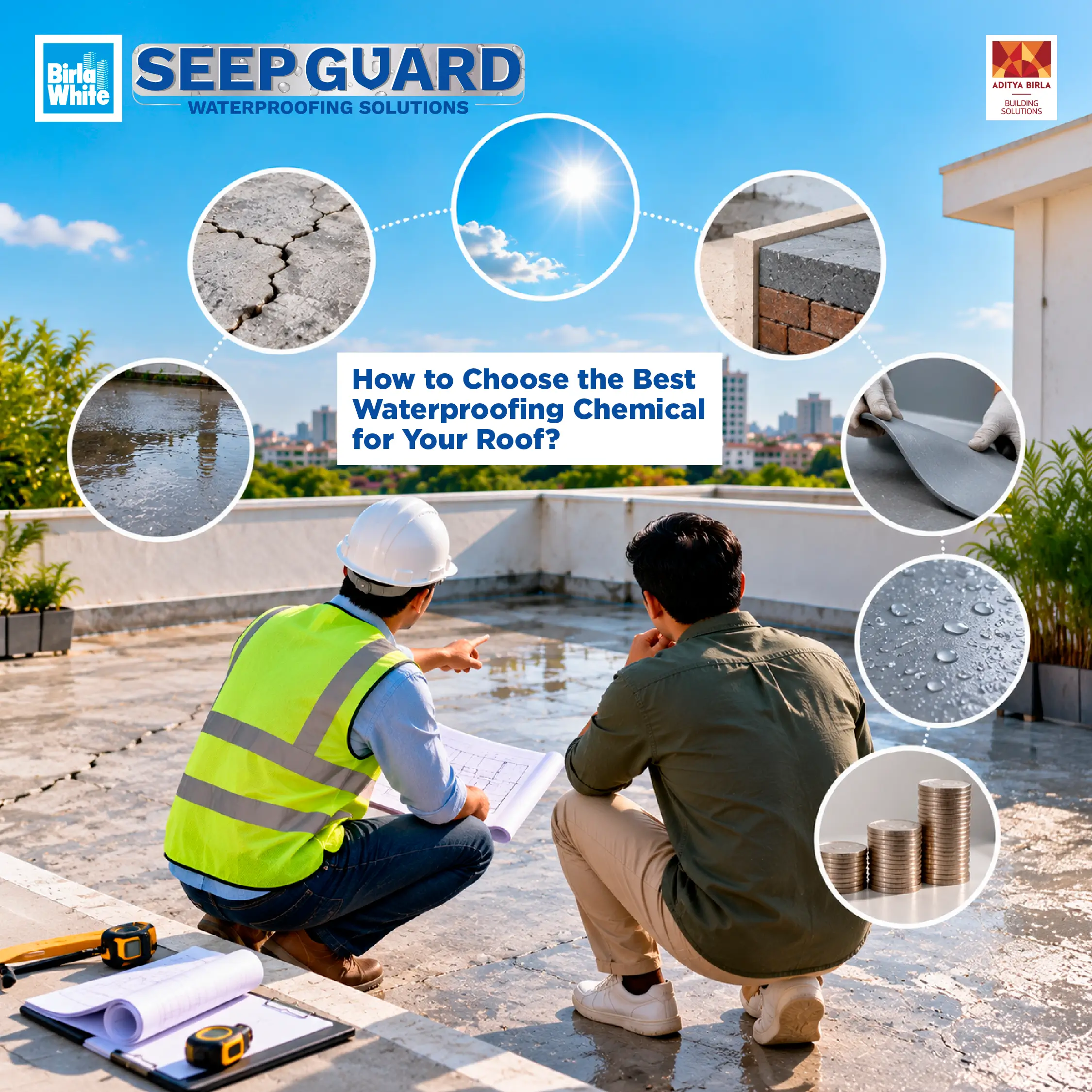
The right choice depends on:
| Factor | What to Check |
|---|---|
| Roof surface | RCC, concrete, cementitious or other substrate |
| Leakage severity | Dampness, seepage, active leakage or waterlogging |
| Crack condition | Hairline, minor or structural cracks |
| Water exposure | Occasional rain or prolonged water exposure |
| Roof movement | Thermal expansion and contraction |
| Drainage | Slope and outlet condition |
| Foot traffic | Whether the terrace is frequently used |
| Application | DIY suitability or professional application |
| Warranty | Product-specific warranty terms |
| Coverage | Area covered per pack |
For horizontal RCC, concrete and cementitious surfaces, Birla White Seep Guard Horizontal Surfaces is one product specifically designed for this application. It offers up to 7-bar hydrostatic pressure resistance, crack-bridging properties and an 8-year waterproofing warranty according to Birla White's product information.
A smarter buying rule:
Don't ask only, "What is the cheapest waterproofing chemical?"
Ask:
"Which waterproofing system matches my roof, and what protection can I expect from the complete application?"
That simple change can help you compare products more meaningfully.
When choosing terrace waterproofing, the product needs to be appropriate for horizontal surfaces and capable of handling prolonged exposure to rain, sunlight and changing temperatures.
Birla White Seep Guard Horizontal Surfaces is formulated with white cement and German elastomeric polymers and is designed for horizontal RCC, concrete and cementitious surfaces.
7-Bar Hydrostatic Pressure Resistance
The product is designed to resist up to 7 bars of hydrostatic pressure.
Crack Bridging
Its elastomeric polymer formulation provides crack-bridging properties to help accommodate suitable minor cracks and surface movement.
Strong Adhesion
The formulation is designed to bond with RCC, concrete and cementitious substrates.
Heat Reduction
Birla White states that application on sun-exposed surfaces can provide a surface-temperature reduction of approximately 6–8°C.
8-Year Waterproofing Warranty
The product page states an 8-year waterproofing warranty, subject to the applicable terms and conditions.
White Cement Advantage
The white cement-based formulation provides a bright coating while contributing to the product's waterproofing system.
One of the most common searches homeowners make is:
But there isn't one fixed price for every roof.
The final cost of roof waterproofing can depend on several factors:
Different waterproofing technologies have different material costs.
A larger terrace requires more material and labour.
A clean and sound surface generally requires less preparatory repair than a terrace with cracks, damaged concrete, old coatings or extensive seepage.
Cracks, honeycombing and damaged areas may require separate repair before waterproofing.
The required quantity depends on the manufacturer's specified application system, coverage and coating thickness.
Professional application can add to the overall project cost.
If water is stagnating because of poor slope or blocked outlets, correcting drainage may be necessary before waterproofing.
Don't compare only ₹/kg
A lower product price does not necessarily mean a lower project cost.
Instead, compare:
Material cost + surface preparation + crack repair + labour + application requirements + expected protection
This gives a more realistic picture of the terrace waterproofing cost.
The right product should always be selected according to the manufacturer's recommended application and the condition of the roof.
Roof leakage rarely remains confined to the roof.
Persistent water ingress can eventually affect:
Roof → Slab → Ceiling → Paint → Interior
That can mean repeated painting, repairs, dampness and maintenance expenses.
A properly planned roof waterproofing system can help protect the terrace while reducing the risk of moisture-related damage to the spaces below.
This is why waterproofing is best considered before visible leakage becomes a recurring problem, rather than only after every monsoon.
The appropriate waterproofing chemical depends on the roof substrate, leakage condition, crack movement, water exposure and application requirements. For horizontal RCC, concrete and cementitious surfaces, Birla White Seep Guard Horizontal Surfaces is specifically designed for this application.
For terrace waterproofing, look for a system designed for horizontal surfaces that offers suitable water resistance, adhesion, durability and crack-bridging performance. Birla White Seep Guard Horizontal Surfaces is formulated for horizontal RCC, concrete and cementitious surfaces.
The price depends on the product, pack size, coverage, terrace area, surface preparation, crack repair and labour. Instead of comparing only the price per kg, calculate the complete project cost.
It depends on the existing tile system, substrate, leakage source and product compatibility. The surface should be assessed before selecting a waterproofing method.
Fill out this form to talk to our experts.
Our team typically replies in 24 hours.