
A freshly painted wall can look flawless on day one. But what happens when the monsoon arrives, humidity rises, or moisture starts travelling through the wall?
That’s when the layer underneath the paint really matters.
Wall putty does more than create a smooth surface for painting. The right putty can influence paint adhesion, finish quality, durability and how well your walls cope with moisture. This is why choosing between waterproof putty and regular putty deserves more attention than simply comparing their prices.
While both types are used to prepare walls before painting, their performance and suitability can differ significantly—especially in humid, monsoon-prone or moisture-exposed areas.
So, what is the difference between waterproof putty and regular putty, and which one should you choose for your walls? Let's find out.
Why settle for ordinary when your walls face rain and humidity? If you're choosing the best putty for your wall in India , consider Birla White WallSeal Waterproof Putty for enhanced water resistance and a durable base that helps your paint finish last.
Give your walls the protection they deserve. Explore Birla White WallSeal Waterproof Putty .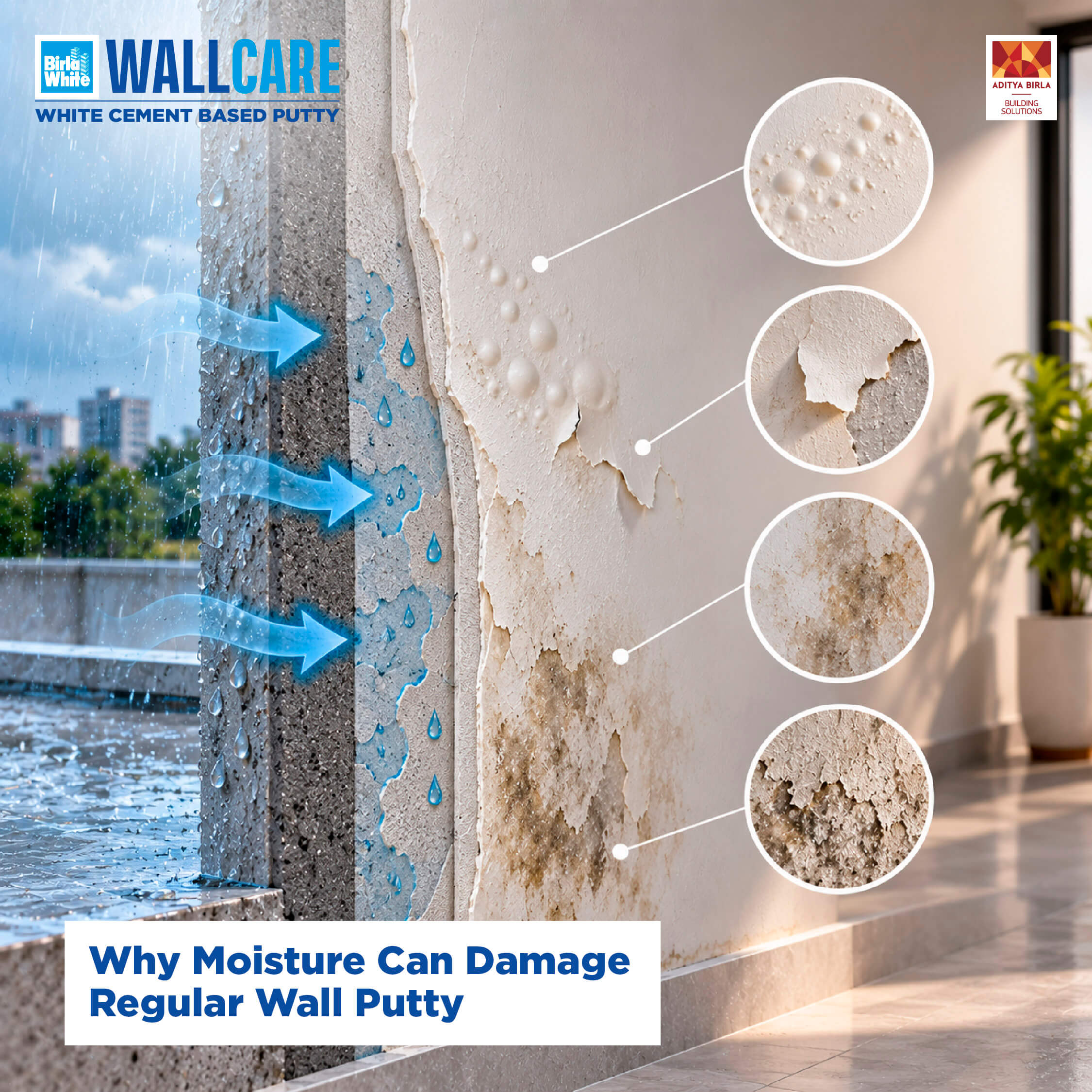
Regular wall putty is primarily used to smoothen and level a wall surface before painting. It fills minor surface imperfections, pores and uneven areas, creating a clean, uniform base for primer and paint. When planning the best wall putty design, choosing the right putty is essential for achieving a smooth and attractive final finish.
It is generally suitable when the primary requirement is a smooth, even and paint-ready surface, particularly in areas where moisture exposure is relatively low. The right application can also help create a more refined base that enhances the appearance of different wall finishes and paint designs.
However, not every regular putty offers the same level of water resistance. Therefore, it is important to check the product's technical specifications rather than assuming that all wall putties provide waterproofing. For walls exposed to humidity or moisture, a suitable waterproof putty may be a better choice for achieving a durable and visually appealing finish.
Regular wall putty can help:
For relatively dry interior spaces, a suitable regular wall putty can be an effective choice. Before applying any putty, follow the correct wall putty application process for proper surface preparation and finishing.
Waterproof putty is a wall-finishing material formulated to provide the usual surface-smoothing benefits while offering enhanced resistance to moisture. It helps create a smooth, uniform base that can support different wall putty design ideas and paint finishes.
Depending on the formulation, waterproof putties can incorporate specialised polymers and other technologies that help reduce water absorption and protect the wall-finishing system from moisture-related deterioration. This makes them particularly useful when you want to achieve an attractive wall finish without compromising moisture resistance.
This makes waterproof putty particularly useful for exterior walls and areas exposed to humidity, rain or dampness. A properly prepared surface can provide a better foundation for your chosen wall finish and overall wall putty design.
However, there is an important distinction: waterproof putty is a protective wall-finishing layer; it should not be considered a complete solution for active structural leakage or severe water seepage. Any underlying source of water must be addressed separately.
Regular putty smooths. Waterproof putty goes a step further. Make the smarter choice for moisture-prone walls with Birla White WallSeal Waterproof Putty , designed with 2X water resistance.
Ready to upgrade your wall protection? Discover WallSeal Waterproof Putty .
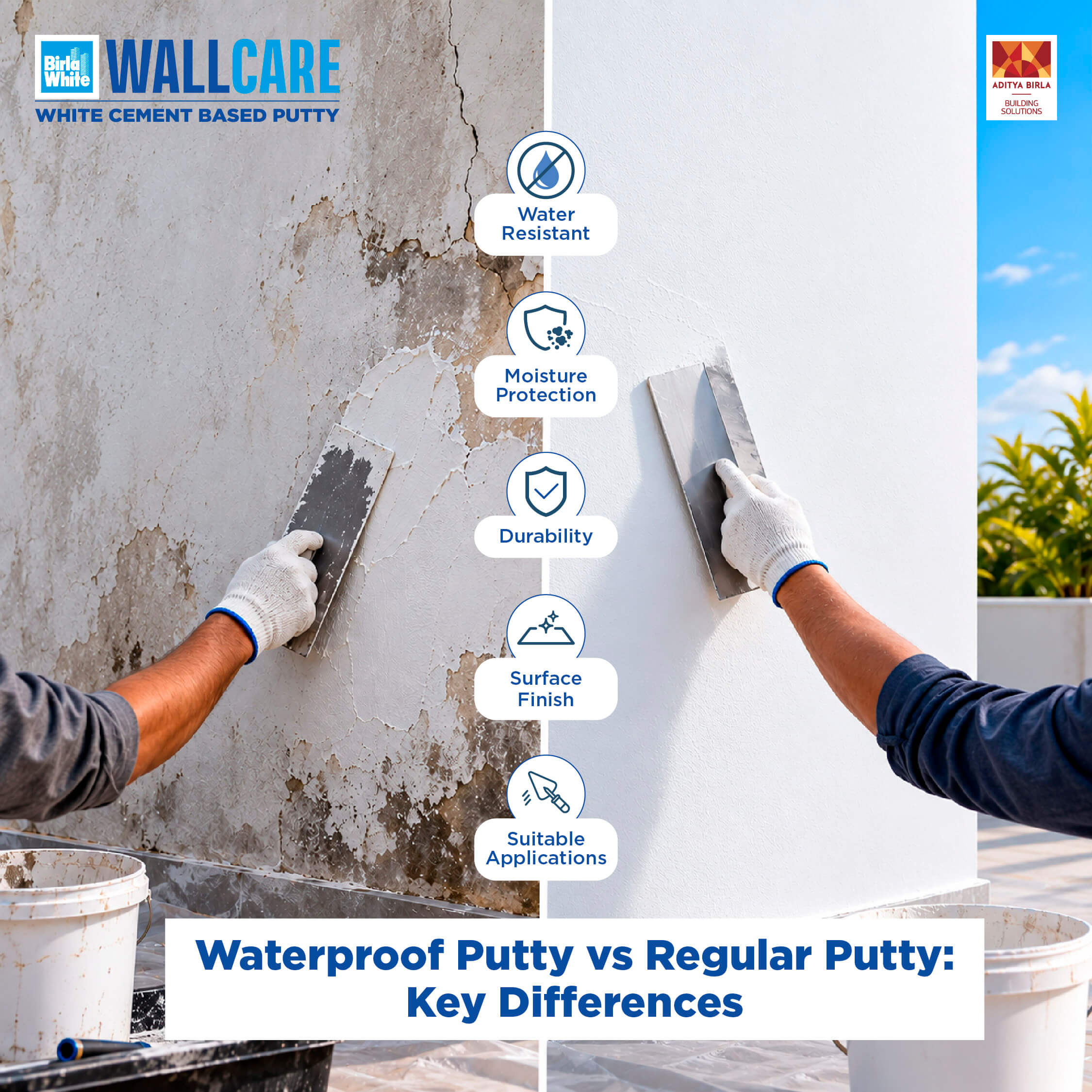
The easiest way to understand the difference is to compare their intended performance.
| Feature | Regular Putty | Waterproof Putty |
|---|---|---|
| Primary purpose | Smoothens and levels walls | Smoothens walls while offering enhanced moisture resistance |
| Moisture resistance | Depends on formulation; generally limited compared with dedicated waterproof products | Specifically formulated for higher moisture resistance |
| Best suited for | Relatively dry interior areas | Moisture-prone, humid and exterior environments |
| Exterior application | Product-dependent | Commonly designed for exterior use |
| Protection against moisture-related paint damage | Depends on the product formulation | Helps reduce moisture-related deterioration |
| Durability in damp conditions | Depends on product | Generally better suited to moisture-exposed conditions |
| Initial cost | Usually more economical | May cost more due to specialised formulation |
| Ideal choice | When smoothness is the primary requirement | When smoothness and moisture protection are both important |
In simple terms: regular putty focuses mainly on surface preparation, while waterproof putty combines surface preparation with enhanced moisture resistance.
There isn't one universal answer. The better option depends on where you are applying it and what your walls are exposed to.
For Indian homes, where seasonal rainfall and humidity can put additional stress on exterior surfaces, choosing a putty designed for the environmental conditions can make a meaningful difference.
Moisture can affect the wall-finishing system and eventually contribute to paint-related problems. A suitable waterproof putty helps reduce water absorption and provides an additional layer of protection.
Paint performs better when applied over a properly prepared and stable base. By improving resistance to moisture, waterproof putty can help reduce the risk of premature paint deterioration.
Walls exposed to humidity and moisture can develop problems such as flaking, patches and deterioration of the finish. A moisture-resistant putty can provide an added line of defence.
If your walls already show signs of moisture, explore these wall dampness solutions before starting the finishing work.
Exterior surfaces have to deal with rain, humidity and changing weather conditions. A waterproof wall putty designed for exterior application can help create a more durable base before painting.
The biggest advantage is that waterproof putty doesn't focus only on aesthetics. A suitable formulation can combine smoothness, adhesion, durability and moisture resistance in the wall-preparation stage.
No. Waterproof putty should not be treated as a complete waterproofing system for a wall.
This is an important point for homeowners.
Waterproof putty helps reduce moisture absorption and provides moisture resistance, but it cannot repair major structural cracks, plumbing leaks, roof leakage or active water seepage.
If your wall already has serious dampness or water leakage, the underlying source should first be identified and treated. Once the surface is properly prepared, an appropriate waterproof putty can be used as part of the wall-finishing system.
Yes, waterproof putty formulated for exterior application can be used on exterior walls.
Exterior walls are exposed to rain, humidity, temperature fluctuations and other environmental conditions. Therefore, choosing a putty specifically designed for exterior use can provide an advantage over using a product intended only for dry interior applications.
Always check the manufacturer's recommended application areas before selecting a product.
Think about your wall's environment before making the decision.
The goal isn't simply to choose the most expensive putty. It's to choose a product whose performance matches the conditions your walls have to face.
For homeowners looking for waterproof putty for walls , Birla White WallSeal Waterproof Putty is designed specifically for enhanced moisture protection.
It is a white cement-based putty with 2X water resistance and Active German Silicon Polymers, creating a strong base for exterior walls. It is designed to help protect walls against water-related damage while providing a smooth, bright surface for subsequent paint application.
Key benefits include:
Explore Birla White WallSeal Waterproof Putty for enhanced protection on moisture-exposed walls.
Before buying wall putty, consider these five factors:
Interior and exterior walls may have different performance requirements.
Consider rainfall, humidity, bathrooms, kitchens, balconies and other moisture-prone environments.
Don't assume every wall putty is waterproof. Check the manufacturer's specifications.
A good base should bond properly with the underlying surface and support the subsequent paint system.
Look for the right combination of smoothness, whiteness, coverage, durability and moisture resistance.
You can also compare application requirements, coverage and wall putty cost before selecting a product.
Waterproof putty can be a better choice when walls are exposed to moisture, humidity or rain because it is formulated to provide enhanced moisture resistance in addition to surface preparation. Regular putty can be suitable for relatively dry interior walls where moisture exposure is minimal.
The primary difference is moisture resistance. Regular putty is mainly used to smoothen and prepare walls, while waterproof putty is formulated to provide enhanced resistance to moisture along with surface-smoothing benefits.
Yes, waterproof putty can be used where it is suitable for the surface and application area. In moisture-prone or exterior areas, a suitable waterproof putty can provide both surface preparation and added moisture resistance.
Yes, provided the product is specifically designed and recommended for exterior applications. Birla White WallSeal Waterproof Putty, for example, is designed for exterior walls and provides 2X water resistance.
Not by itself. Waterproof putty can help reduce moisture absorption, but active leakage, plumbing problems, structural cracks or significant seepage require separate waterproofing or repair measures.
A suitable waterproof putty can help reduce moisture-related paint deterioration by providing a more moisture-resistant base. However, proper surface preparation, application and treatment of the underlying moisture source are also essential.
Waterproof putty may have a higher initial cost because of its specialised formulation. However, the right product can offer additional moisture protection and may help reduce premature maintenance caused by moisture-related wall damage.
For walls exposed to heavy rain or high humidity, a waterproof putty designed for the relevant application can be a suitable choice. It is particularly important for exterior walls and other moisture-exposed surfaces.
Regular putty can give your walls the smooth foundation they need. Waterproof putty can take that foundation a step further by adding enhanced resistance to moisture.
So, when deciding between waterproof putty vs. regular putty, don't look only at the upfront price. Consider your wall's location, moisture exposure, weather conditions and expected durability.
For moisture-prone and exterior surfaces, choosing a purpose-designed waterproof putty such as Birla White WallSeal Waterproof Putty can help create a stronger, smoother and more moisture-resistant base for your paint finish.
Because beautiful walls don't just need a great colour—they need the right foundation underneath.
Fill out this form to talk to our experts.
Our team typically replies in 24 hours.


