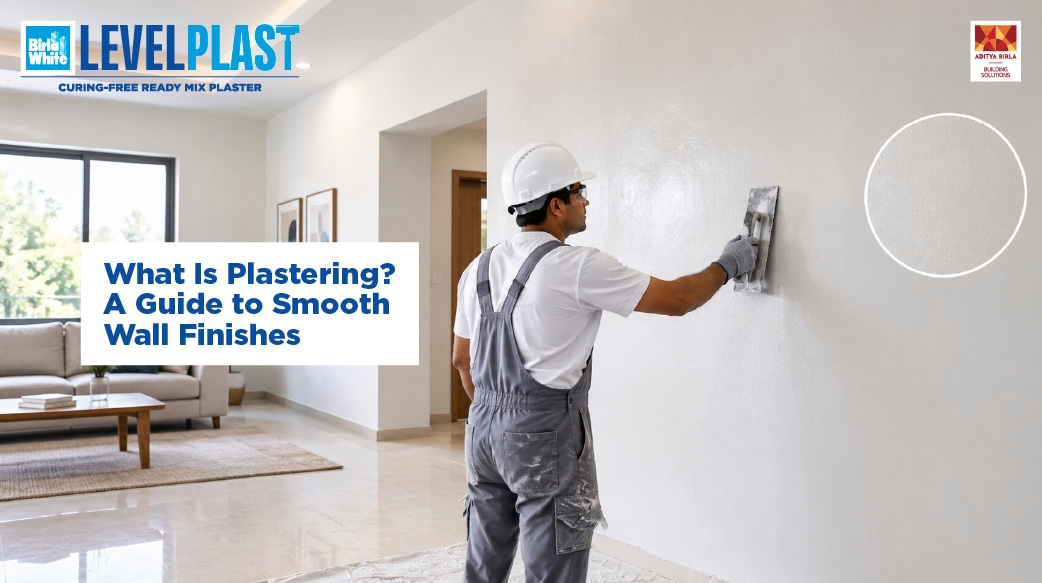
When undertaking construction projects, plastering is an important stage that helps create a smooth surface on walls and ceilings. Choosing the correct plaster type for construction allows you to achieve a durable and uniform finish.
Ready-mix plasters are commonly used for plastering walls, while POP (Plaster of Paris) is more frequently used for decorative features and certain interior applications.
Understanding the differences between ready-mix plaster and POP helps homeowners, contractors and builders make informed decisions. This article explores the benefits of ready-mix plaster, explains what Plaster of Paris is, compares the two options and highlights why Birla White Levelplast may be a suitable choice for your construction project.
It is the process of applying a layer of plaster to surfaces such as walls and ceilings to create a smooth and even finish. It helps cover surface imperfections and provides a suitable base for painting and other finishing treatments.
The type of plaster used depends on the surface, environmental conditions and the finish you want to achieve.
Common types of plaster include:
Ready-mix plaster is a factory-manufactured product made using carefully proportioned ingredients. These may include binders, graded aggregates and additives, depending on the plaster formulation.
It is generally available in dry form and requires a specified quantity of water before application. This eliminates the need to measure and mix individual ingredients on-site, making the plastering process more convenient.

Some of the key benefits of ready-mix plaster include:
Factory-prepared mixtures help maintain consistent ingredient proportions, supporting a more uniform application and finish.
Ready-mix plaster is convenient to prepare. Simply add the recommended quantity of water and mix according to the manufacturer's instructions.
A standardised mix simplifies on-site preparation by reducing the need to measure individual ingredients manually.
The exact application and performance of ready-mix plaster depend on its technical specifications. Always check its suitability for the surface, required thickness and interior or exterior application.
Although both ready-mix plaster and POP are used for surface finishing, they differ in their composition, applications and preparation methods.
| Comparison Factor | Ready-Mix Plaster | POP (Plaster of Paris) |
|---|---|---|
| Manufacturing | Factory-prepared mixture with proportioned ingredients, depending on the product formulation. | Gypsum-based plaster made from calcium sulphate hemihydrate. |
| Typical Uses | Wall plastering and masonry applications, depending on product specifications. | Decorative features, cornices, false ceilings and certain interior applications. |
| Mixing | Generally mixed with a specified quantity of water before application. | Mixed with water to achieve the required consistency. |
| Uniformity | Consistent mixture due to factory-controlled ingredient proportions. | Consistency depends on the product and mixing method. |
The main difference is that ready-mix plaster can be a practical option for general wall plastering, while POP is commonly used for decorative features and selected interior applications.
Neither option is universally better than the other. The right choice depends on your project requirements, surface compatibility and the manufacturer's recommendations.

If you need to carry out suitable masonry plastering work, ready-mix plaster can be a practical choice. Here are some of its key advantages:
Since ready-mix plaster is factory-manufactured, it helps reduce inconsistencies in ingredient proportions. This is useful when achieving a similar finish across multiple rooms or floors.
Ready-mix plaster simplifies preparation because there is no need to measure each individual component. Simply follow the manufacturer's instructions and add the recommended quantity of water.
When selected according to the substrate and application requirements, ready-mix plaster can provide a suitable solution for masonry surfaces. POP, on the other hand, is generally preferred for decorative features.

A smooth wall finish depends on the quality of the plaster, proper surface preparation, correct mixing and application techniques. Following the recommended curing or drying process is equally important.
Using ready-mix plaster can help achieve a uniform finish through the following steps:
Since the plaster is factory-manufactured, its ingredient proportions are controlled, helping reduce inconsistencies during application.
Ensure that the surface is clean and free from dust, loose particles, oil and other impurities. Follow the product instructions for surface preparation, which may include moistening the substrate.
Always use the recommended quantity of water specified by the manufacturer. Incorrect mixing can affect the workability, adhesion and final finish of the plaster.
Choosing the right plaster requires considering the surface, application location and desired finish. Here are some important factors to evaluate:
Identify whether the plaster will be used for interior walls, exterior walls, ceilings, decorative areas or surface repairs.
Ensure that the plaster is suitable for the substrate, whether it is brickwork, concrete, AAC blocks or another masonry surface.
Consider factors such as adhesion, strength, working time and moisture exposure. For areas exposed to dampness, choose a product specifically recommended for those conditions.
Depending on the desired finish, you may need additional wall putty, primer or other finishing products before painting.
When exploring ready-mix plaster options, Birla White Levelplast is worth considering. It is important to select a product that suits your surface, application requirements and desired finish.
Refer to the latest product brochure and technical documentation to understand its features, application guidelines and suitability for your construction project.
Choosing the right plaster for construction helps create uniform walls and provides a suitable base for further finishing. While POP is commonly used for decorative applications, ready-mix plaster can be a practical option for suitable masonry plastering work.
Ready-mix plaster is a factory-prepared plastering material containing proportioned ingredients such as binders, graded aggregates and additives. It typically requires only the specified amount of water before application, making wall plastering more convenient and helping achieve a consistent finish.
Yes, ready-mix plaster can be an excellent choice for wall plastering because it offers consistent material proportions, convenient preparation and a uniform surface when applied correctly. It can also reduce errors associated with manual mixing. The best results depend on selecting a product suitable for the substrate and following the manufacturer's application instructions.
The best ready-mix plaster depends on your construction requirements, including the wall surface, interior or exterior application, desired finish and budget. Birla White Levelplast is an option to consider when evaluating ready-mix plaster solutions. Check its latest technical specifications to confirm suitability, coverage and application requirements for your project.
To use ready-mix plaster, first clean and prepare the wall surface according to the manufacturer's instructions. Mix the plaster with the recommended quantity of clean water until uniform, apply it at the specified thickness and level the surface using suitable tools. Follow the product instructions for finishing, curing and drying before applying paint or other finishing materials.
The drying time of plaster depends on its formulation, application thickness, temperature, humidity and ventilation. The surface may become touch-dry before it is ready for painting. Cement-based plaster also requires appropriate curing. Always follow the manufacturer's recommendations for curing, drying and applying subsequent finishes.
The coverage of ready-mix plaster depends on the bag size, application thickness, surface unevenness and material wastage. For an accurate estimate, check the manufacturer's stated coverage per bag at the recommended thickness.
You can estimate the required quantity using this formula:
Number of Bags = Total Wall Area (m²) ÷ Coverage per Bag (m²)
For example, if one bag covers 2 m² under the specified application conditions, a 100 m² wall area would require approximately 50 bags, excluding additional material for wastage and surface variations. Always use the actual coverage specified for your chosen product.
Fill out this form to talk to our experts.
Our team typically replies in 24 hours.